Saturday 28 March 2015


Monday 26 January 2015
Right to bid gets a new feature for valued community pubs
The government is proposing to make a small but significant change to the planning system.
Community valued pubs that are registered as assets of community value will be stripped of their permitted development rights, meaning that a planning application will be required to convert them to other uses, or demolish them, without sale.
This is an extension of community listing in order to secure a right to bid on sale, into development control. It is entirely possible that other types of use class could gain additional planning protections in future.
 |
| The Ivy House in Nunhead was listed as an asset of community value |
My advice to communities who are unsure about listing, is to list those assets! It isn't supposed to be a reactive right. If a building is already under threat, it might be too late. This does ignore the way most communities respond to threats, but that is a weakness of the legislation. Intriguingly, pubs are the most popular category of development to be listed so far.
The Communities and Local Government committee have a report due in February into community rights. There is also a plan to look at how the right to bid and nomination process has been implemented. Currently there is no standard form and it can be unclear what information is required or where to send it.
Tuesday 22 July 2014
What do you love about where you live?
Article originally appeared in Sustain.
One Sunday in July I stood in a small park in a Central London and asked people to pin cards to a tree, telling me what they loved about the community around them. Not to exclude digital natives I also selected a hashtag and invited responses through social media. The fantastic responses I got were an incredibly useful start to developing a neighbourhood plan.

Neighbourhood planning requires wide engagement and an evidence basis to meet the statutory requirements of the Localism Act. Although having a public meeting and setting up a WordPress blog, Twitter account and such are undoubtedly useful, following the maxim “go where the people are” is also essential in order to create a plan that has legitimacy.
Monday 21 July 2014
#loveaboutsoho
I'm asking people what they love about the Soho neighbourhood, both online and at events. The responses are interesting and can be found on Twitter.
Thursday 22 May 2014
Historic day for London and Queen's Park
Elections taking place in the Queen's Park ward of Westminster today are truly historic. As well as the London region MEPs and councillors on Westminster City Council, residents of Queen's Park are voting for truly local councillors to represent them on Queen's Park Community Council.
Queen's Park Community Council is the first ever parish council in Inner London and the first in Greater London as a whole since 1936.
The Queen's Park area of Westminster has no history of truly local democracy. It has always been subject to remote administration. Before 1900 from Chelsea, until 1965 from Paddington and currently from Westminster.
Most local government services will continue to be provided by Westminster City Council, but now Queen's Park has the ability to act for itself and respond to issues locally. Communities all over London should be interested to learn what they are able to achieve.
Queen's Park Community Council is the first ever parish council in Inner London and the first in Greater London as a whole since 1936.
 |
| The parish is divided into areas to elect twelve councillors |
Most local government services will continue to be provided by Westminster City Council, but now Queen's Park has the ability to act for itself and respond to issues locally. Communities all over London should be interested to learn what they are able to achieve.
Monday 31 March 2014
A parish council for Barking Riverside?
The latest area in London to look at setting up a parish council is Barking Reach. This area, also known as Barking Riverside, was in the news recently because of plans to connect it to the London Overground so further house building can take place. As much of the area is undeveloped, delineating boundaries should not be as problematic as it can be elsewhere in the urban sprawl.
The organisers of the parish council plan have benefited from the new councils grants that are promoted by the Department for Communities and Local Government and the National Association of Local Councils in order to assist in setting up a council.
 |
| The boundary follows the new development area |
Thursday 27 March 2014
What next for localism? What next for London?
On Wednesday 26 March 2013 the National Association of Local Councils (NALC) held an event asking the question "What next for localism?" It was attended by everyone from parish councillors and clerks to the minister and shadow minister for local government. Also represented were academics, officers from principal authorities and the Local Government Association.
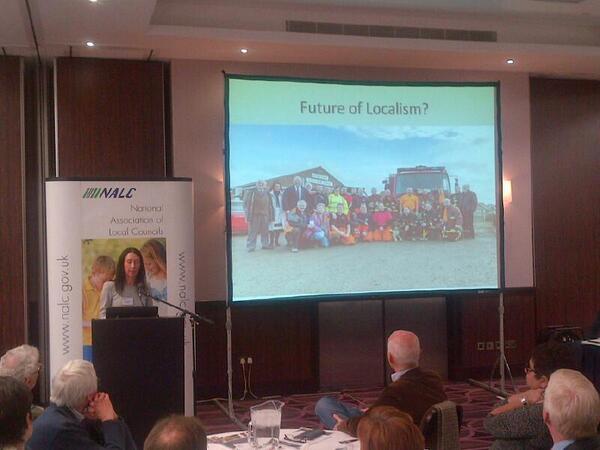 |
| Speakers came from every level of community, local and national government |
"What next for localism?" is a useful to question to ask at this time. A general election is a year away and the flavour of government that will be returned is far from certain. Which isn't to say the political parties are offering dramatically divergent policies right now, there appears to be consensus for "more localism". However, the event was much more focussed on what those involved in delivering community governance had to say. The delegates had a few messages for the ministers.
We've been doing localism for over 100 years
Delegates were keen to note that localism didn't just happen with the Localism Act 2011 or any other piece of legislation. Town and parish councils have been offering a wide variety of services for some time, either alone or more typically by forming partnerships with other tiers of local government or agencies. The flip side of this was a sense that the coalition hasn't "done localism" by passing the Localism Act.
One size does not fit all
Another theme explored was that the powers available to councils, such as neighbourhood planning, right to challenge and right to bid will not be taken up by every council. Many councils felt able to achieve their objectives without having to 'challenge' anyone. There was also a fear of devolution of bureaucracy occurring, where new powers create new processes that waste time and resources.
Finance, finance, finance
We've been doing localism for over 100 years
Delegates were keen to note that localism didn't just happen with the Localism Act 2011 or any other piece of legislation. Town and parish councils have been offering a wide variety of services for some time, either alone or more typically by forming partnerships with other tiers of local government or agencies. The flip side of this was a sense that the coalition hasn't "done localism" by passing the Localism Act.
One size does not fit all
Another theme explored was that the powers available to councils, such as neighbourhood planning, right to challenge and right to bid will not be taken up by every council. Many councils felt able to achieve their objectives without having to 'challenge' anyone. There was also a fear of devolution of bureaucracy occurring, where new powers create new processes that waste time and resources.
Finance, finance, finance
Perhaps unsurprisingly finance was a theme that came up. Councils have lost out because of changes to council tax support, where money isn't always passed on by principal authorities. Local councils are concerned about referendums for precept increases that might be implemented. Looking to the future, councils want to keep some of the business rates that are collected in their area, given their role in creating places for businesses to thrive.
Planning and housing
Housing came up as a theme throughout the day. Local councils are excluded from the New Homes Bonus intended to incentivise house building. As this scheme has not met its goals, devolving it to local councils could be the answer. It will also allow communities control over where houses are built. There was a sense that the removal of regional strategies hadn't devolved powers over planning enough and local councils needed to be involved.
The reception to neighbourhood planning was surprisingly ambivalent. Smaller parishes with meetings rather than councils are excluded and even some parishes with councils felt it was too bureaucratic a process for too little gain. There was also concern that there wasn't adequate safeguard that plans would be followed. Annette Brooke, representing the Liberal Democrats on local government, said a right of appeal might need to be created.
Wrong way round
More radical ideas came from academics who suggested it was about time councils had a constitutional right to exist and shouldn't be granted that right and powers piecemeal from the centre. Principal authorities shouldn't have the power to remove councils and, ideally, everywhere should have a parish council. This frames "what next?" as whatever each council needs. It became clear that councils don't just use powers as they become available, they select them based on their own local requirements.
What next for London?
The take up of parish councils and powers such as neighbourhood planning in London has been slow. The radical idea of systematically creating parish councils might be the only way to get these initiatives moving. However, localism is at best a "bottom up" exercise. Having a share of business rates might encourage parish councils to form in London that otherwise wouldn't. The fear of taxation through precept would be turned on its head with the prospect of a revenue stream being 'lost' without a local council to make use of it. The experience of councils outside London with regards to the new powers available could be useful to communities in London. Many were able to do the things they wanted through informal partnership working. So, perhaps the benefit of forming new parish councils in London isn't about gaining new powers, but creating a structure that will give the community a voice and the corporate form needed to act.
What next for London?
The take up of parish councils and powers such as neighbourhood planning in London has been slow. The radical idea of systematically creating parish councils might be the only way to get these initiatives moving. However, localism is at best a "bottom up" exercise. Having a share of business rates might encourage parish councils to form in London that otherwise wouldn't. The fear of taxation through precept would be turned on its head with the prospect of a revenue stream being 'lost' without a local council to make use of it. The experience of councils outside London with regards to the new powers available could be useful to communities in London. Many were able to do the things they wanted through informal partnership working. So, perhaps the benefit of forming new parish councils in London isn't about gaining new powers, but creating a structure that will give the community a voice and the corporate form needed to act.
Friday 13 December 2013
LinkedIn group
I've started a group London Community Governance on LinkedIn for sharing links and discussion related to community governance in London. Please join in!
Friday 4 October 2013
Book: Local Councils Explained
The National Association of Local Councils (NALC) has published
a book which aims to be a comprehensive guide to the workings of parish councils, also known
as town, community or neighbourhood councils and collectively “local councils”.
Local Councils
Explained is a much needed publication, in part because of the additional
powers available to parish councils since 2010. The book has been written by
the NALC head of legal services, Meera Tharmarajah and has a sound basis in the
legislative framework councils inhabit, but is also an accessible document,
written in a style that is engaging and clear.
.jpg) |
| The book include all relevant information for the running of a local council |
There is no one single piece of legislation governing parish
councils and the powers and functions are drawn from legislation going back
over 100 years. A guide such as this is therefore invaluable to anyone with an
interest in the workings of local councils, including parish clerks and of
course councillors.
In particular, those trying to set up new councils in areas
that have no recent or nearby experience to guide them, such as in London, will
benefit from the book and several chapters have been written with them in mind.
The book went on sale on 4 October and is available from NALC.
Friday 27 September 2013
Making it easier to set up new town and parish councils?
The Department for Communities and Local Government ran a consultation on the process of setting up new town and parish councils that closed in January 2013. The results of this consultation were published in September.
The test of these measures will be how quickly a new council can be set up under the adapted guidance. In the case of Queen's Park the council added the extra challenge of a local referendum. This kind of extra hurdle is not to be explicitly prevented. Within London perhaps part of the problem is the lack of experience the borough councils have of parish councils. However the community governance review was introduced to London at the same time as the rest of the country and other parish councils have been set up under the 2007 regime in less time. The reduction in signatures needed to trigger a petition might make campaigners feel they have less of a challenge in order to start the review process. The other changes should ensure the review happens in a timely manner. Hopefully a community will want to test this out soon, so I can do a comparison!
Since the Local Government and Public Involvement in Health Act 2007 authorities such as London borough councils have the role of deciding if new parish councils should be formed in their area. Previously this decision was centralised. The 2007 act introduced a procedure called a community governance review which could be triggered by local petition. In London this procedure was triggered in 2011 by the Queen's Park ward of Westminster and led to the creation of a new parish council in 2014. The length of time it took to create this parish council points to the failings in the existing system. The campaign was well organised and followed the procedure as set out.
The responses to the consultation came from principal councils, parish councils and individuals, and are were overall in favour of some changes to the process of setting up a parish council. The options available were:
- amending existing guidance;
- changing the law;
- making it easier for neighbourhood forums (used for neighbourhood planning) to start the process for creating a new parish council; or
- some combination of the above.
The responses broadly favoured the changes proposed in all options, with some respondents strongly opposed to changes in each category.
The government response similarly proposes changes drawn from each option:
- limiting the time for a community governance review to twelve months from the receipt of a valid petition;
- reducing the number of signatures needed on a petition for a community governance review;
- making it easier for neighbourhood forums to start the process for setting up new parish councils; and
- amending guidance to local authorities undertaking community governance reviews to favour parish council proposals.
The test of these measures will be how quickly a new council can be set up under the adapted guidance. In the case of Queen's Park the council added the extra challenge of a local referendum. This kind of extra hurdle is not to be explicitly prevented. Within London perhaps part of the problem is the lack of experience the borough councils have of parish councils. However the community governance review was introduced to London at the same time as the rest of the country and other parish councils have been set up under the 2007 regime in less time. The reduction in signatures needed to trigger a petition might make campaigners feel they have less of a challenge in order to start the review process. The other changes should ensure the review happens in a timely manner. Hopefully a community will want to test this out soon, so I can do a comparison!
Sources:
Monday 8 April 2013
Save our pub!
The community in Nunhead, Southwark have organised and successfully used the 'community right to bid' part of the Localism Act 2011 to prevent their local pub from being sold to developers. It will now be run as a co-operative enterprise.
Meanwhile in Elm Park, Havering a similar 1930s pub is being sold off for development and the community aren't happy. However, the voices there have not organised in order to use the rights the community have available to them.

Meanwhile in Elm Park, Havering a similar 1930s pub is being sold off for development and the community aren't happy. However, the voices there have not organised in order to use the rights the community have available to them.

In both areas the community identified the pubs for what they were, the scarce resource of an enclosed public space. But what happened to make the Nunhead group organise and held back the group in Elm Park?
It might have been luck. It might be something to do with social capital. Perhaps the Elm Park group had not heard about the rights available to them? It could be that the Nunhead group cared more, or felt they did not have enough alternative facilities. It might have been because of effective leadership.
More questions than answers I'm afraid. One of things I am trying to learn in my PhD thesis is why some communities are able to come together to organise and others do not.
Friday 18 January 2013
Response to DCLG consultation on setting up town and parish councils
The Department for Communities and Local Government recently closed a consultation on making it easier to set up new town and parish councils. The current legislative framework for this was set down in 2007. I responded to this consultation and recommended a number of amendments to existing policy, including legislative changes.
The consultation presented a number of problems that campaigners for new parish councils might encounter. These include the lengthy timescales to set up a parish council and the administrative burden. Looking at the example of Queen's Park these two problems appear interrelated. The group started discussions to form a council in 2010, followed the relevant procedures, were successful in their efforts, but will not come into their powers until 2014.
DCLG presented three options for improving the process of setting up town and parish councils. They were keen to stress that these are not mutually exclusive and some elements of each option could be brought forward. I am of the opinion that such an approach is necessary to achieve the aims of the consultation.
I support amending guidance to reduce the timescales of the community governance reviews. However, without statutory compulsion there is a risk that valid proposals could still be delayed in bureaucracy. Therefore a change must be made to legislation in addition to the guidance. I also support the proposal to create an easier route for neighbourhood forums (used for neighbourhood planning) to become parish councils.
The proposal to reduce the scope of the community governance reviews might have some unintended to consequences in Greater London and I highlighted some other factors that might be more specific to London where there is no recent experience of parish councils. The full response is available online.
The consultation presented a number of problems that campaigners for new parish councils might encounter. These include the lengthy timescales to set up a parish council and the administrative burden. Looking at the example of Queen's Park these two problems appear interrelated. The group started discussions to form a council in 2010, followed the relevant procedures, were successful in their efforts, but will not come into their powers until 2014.
DCLG presented three options for improving the process of setting up town and parish councils. They were keen to stress that these are not mutually exclusive and some elements of each option could be brought forward. I am of the opinion that such an approach is necessary to achieve the aims of the consultation.
 |
| Campaigners may find it demanding to create a parish council |
The proposal to reduce the scope of the community governance reviews might have some unintended to consequences in Greater London and I highlighted some other factors that might be more specific to London where there is no recent experience of parish councils. The full response is available online.
Tuesday 8 January 2013
Community on Google+
There is now a Googe+ Community for issues around community governance. This is a place to share links, discuss and exchange ideas.
Wednesday 26 December 2012
Making it easier to set up new town and parish councils
The Department for Communities and Local Government is consulting on changes to the way parish and town councils are set up in England.

Since the 2007 legislation that allowed parish councils to be formed in Greater London, a new mechanism called a community governance review has been used to create town and parish councils. This represented a devolution of power from the secretary of state to the principal local authorities.
Taking Queen's Park as an example, the only successful parish council in London to date, it took four years from having the idea to form a council in 2010 to coming into their powers in 2014. This is partly due to electoral cycles, but also the guidance for governance reviews which allows local authorities in excess of a year to set the terms of reference and complete the review.
The governance review is only triggered once enough signatures have been collected on a petition. The consultation makes a number of suggested changes to the guidance for principal authorities and has the option of changes to legislation. The department would like responses to their consultation by 9 January 2013.

Community governance reviews are triggered by a petition
Taking Queen's Park as an example, the only successful parish council in London to date, it took four years from having the idea to form a council in 2010 to coming into their powers in 2014. This is partly due to electoral cycles, but also the guidance for governance reviews which allows local authorities in excess of a year to set the terms of reference and complete the review.
The governance review is only triggered once enough signatures have been collected on a petition. The consultation makes a number of suggested changes to the guidance for principal authorities and has the option of changes to legislation. The department would like responses to their consultation by 9 January 2013.
Thursday 11 October 2012
YouTube Channel
I've started a YouTube channel to share videos that I find related to community governance in London. You can subscribe here.
Tuesday 14 August 2012
Who will be next...?
Had a bit of time to check for evidence of communities thinking about forming parish councils. Queen's Park have been successful and will form a parish council in 2014. But what of the other attempts? I can find fifteen and all are at very different stages. The earliest stage of forming a parish council appears to be a period of discourse. This is often internet-based and then spills over into local newspapers, or is triggered by a local politician and perhaps involves correspondence with the local council. The setting up of a dedicated website or Facebook group is an indicator things are moving along and that there is someone driving the proposal forward. Things are really getting serious when there is a public meeting. London Fields and Wapping have reached this stage, but not beyond it. Only Queen's Park have successfully moved to the stage of petitioning the local council for a governance review.
 |
| See below for key to prospective councils |
But what do these prospective councils point to? Firstly the geographical spread is interesting. Not only are the majority in the Inner London area that has no history of parish councils, but many are on the central London fringe. Only Chingford fits the anticipated profile of a community on the Greater London boundary looking to copy the experience of communities on the other side. Often the desire to form a council references something about identity and difference to "the rest" of the borough in which the community is situated. Communities on edges and boundaries (Crystal Palace, Forest Gate, Kilburn and Thamesmead) are notably present. But parish councils cannot cross borough lines and cannot be used to ameliorate for the effects of London's often arbitrary (although often ancient) borough boundaries. It would be wrong to suggest people want to form parish councils for political reasons, but often the political profile of these areas differs from the rest of the local authority.
Back to the question "Who will be next...?" It is hard to say, as no community seems anywhere near as driven as the Queen's Park campaign. The most activity appears to be around the idea of councils in the north of Southwark, which is interesting as this borough has the most significant devolved area committee arrangements in Greater London. Has this experience been enough to convince the community they want more?
Bermondsey (Southwark)
Borough & Bankside (Southwark)
Chingford (Waltham Forest)
Forest Gate (Newham)
Harlesden (Brent)
Kilburn (Camden)
London Fields (Hackney)
Mayfair (Westminster)
Mitcham (Merton)
Norton Folgate (Tower Hamlets)
Upper Norwood (Croydon)
Queen's Park (Westminster)
Thamesmead (Bexley / Greenwich)
Wapping (Tower Hamlets)
Waterloo (Lambeth)
Borough & Bankside (Southwark)
Chingford (Waltham Forest)
Forest Gate (Newham)
Harlesden (Brent)
Kilburn (Camden)
London Fields (Hackney)
Mayfair (Westminster)
Mitcham (Merton)
Norton Folgate (Tower Hamlets)
Upper Norwood (Croydon)
Queen's Park (Westminster)
Thamesmead (Bexley / Greenwich)
Wapping (Tower Hamlets)
Waterloo (Lambeth)
Wednesday 1 August 2012
Planning Aid for London: Other Models for Neighbourhood Planning in London
In July I spoke at a Planning Aid for London event on neighbourhood planning in London, the creation of urban parishes and alternative forms of community governance. The slides from the event are available here.
Friday 29 June 2012
Does success for Queen’s Park Parish Council point to how others will fail?
I've been looking forward to the opportunity to write a little about Queen's Park and their bid to form a parish council in London. This community has been the first to gain the necessary approval of their local authority. What is notable about this group is the speed in which they have been able to do this. The legislative powers to form parish councils in London were granted in 2007 and became available from 2008. However, the community did not look to form a parish council until after the general election in 2010. The election of the first parish councillors will take place in May 2014. Four years to set up a parish council may seem a long time, but given the administrative and other hurdles to get over it is difficult to see how they could have done it any quicker. I believe it is unlikely that any other group will be able to repeat their speedy success. I'm going to set out the hurdles a prospective parish council faces and why I think this group overcame them.
Boundaries: where does our community end?
Boundaries: where does our community end?
The first hurdle is deciding on boundaries. Where does the community begin and end? This is much more problematic in Greater London than anywhere else because of the endless urban sprawl. Our communities are officially defined only by relatively large boroughs (32 covering 8 million people) and electoral wards (624 of them) that rarely coincide with what we would call a community. An added complication is that civil parishes cannot cross borough boundaries. So communities that sprawl into other boroughs cannot be united as one. In Queen's Park they chose to use an electoral ward. There are a variety of reasons for this. Firstly, it was already being used as a neighbourhood area by Paddington Development Trust so is an existing functional community for governance purposes. Secondly, administrative geography meant that the ward is surrounded on three sides by other boroughs with an isthmus connecting it to Westminster. Far from a protracted discussion on boundaries which could delay another parish council proposal, the boundaries were already self-evident and not a point of contention.
Support, powers and precept
The next hurdles connect with the need to get support. The first is the extent to which a parish council is understood to have sufficient powers to be worthwhile and the second is the extent to which paying increased council tax (known as a precept) is considered acceptable by the community. In the case of Queen's Park the reason for setting up the council was to secure a new means of funding. The grant from government had been cut and the community needed to find a new way to fund local activities. The problem of the precept was therefore turned on its head. Far from being an onerous means to an end, it was the very mechanism the community required and a way for them to help themselves. The other power of the parish council, often overlooked, was the permanence. The structures that had relied on ad hoc grants from government were under threat, but a new parish council would not face abolition merely because of limited funds. The powers of the parish council are fairly limited and this puts off some groups going through the effort of setting one up. In Queen’s Park there were at least two powers they could identify as worth the trouble.
Petition for a community governance review
Gathering popular support is a requirement for setting up a parish council. In order to force the local council to consider setting one up it is necessary to trigger a community governance review. This is done by organising a petition which must be signed by at least 10% of electors. In Queen’s Park there was a very well organised campaign which maximised limited resources. The existing community governance infrastructure and access to a community empowerment practitioner undoubtedly helped to make this petition a success. Genuine community support for the proposal was also present and vital to a such a bid succeeding. As Westminster is a focus for London regional media it was possible for the group to gain some considerable publicity. Had the campaign been in Hillingdon or Sutton this might not have been so easy to achieve.
Petition for a community governance review
Gathering popular support is a requirement for setting up a parish council. In order to force the local council to consider setting one up it is necessary to trigger a community governance review. This is done by organising a petition which must be signed by at least 10% of electors. In Queen’s Park there was a very well organised campaign which maximised limited resources. The existing community governance infrastructure and access to a community empowerment practitioner undoubtedly helped to make this petition a success. Genuine community support for the proposal was also present and vital to a such a bid succeeding. As Westminster is a focus for London regional media it was possible for the group to gain some considerable publicity. Had the campaign been in Hillingdon or Sutton this might not have been so easy to achieve.
Once the petition is submitted to the borough council they have a year in which to consider the proposal. There are a number of things that could delay or derail a proposal. It cannot proceed if it is felt the proposed boundaries are not viable, for example by leaving a small part of the borough cut off from the rest, and unable to form parish council in future. As part of the governance review the council will consider the whole borough, not just the area of the proposal. The borough council can choose to approve the new parish or suggest amendments to the proposal, which might include changing the boundaries. The council could divide the whole borough up into civil parishes. This is exactly what happened in Milton Keynes in 2001.
Final hurdle
In the event Westminster did none of these things. It agreed the parish council in principle as proposed, but produced a final hoop for the community to jump through: a non-binding referendum of local electors. I believe adding this step points to the ambivalence of local authorities to parish councils. They are neither enthusiastically behind them nor outright in opposition to them. If they were so minded, Westminster could have rejected the proposal and justified it with a range of reasons. But at the same time they could have approved it at this point, based on the petition, dialogue with the proposers and the responses to the governance review consultation.
68% of electors voted to approve the parish council and the first elections will take place in May 2014 at the same time as the London borough council elections. It may seem like a lengthy process, and it is. However, Queen’s Park have probably navigated it about as quickly as is possible. Other campaigns have got stuck very early in this process and even had they got past initial conversations about boundaries the introduction at the last minute of additional hurdles such as a referendum might have derailed them entirely. Queen’s Park represented a well organised and well supported campaign, and Westminster a typical local authority in terms of its attitude to community governance. Without the special set of circumstances that existed in Queen’s Park it is unlikely that we will be seeing the introduction of further parish councils in London soon.
Final hurdle
In the event Westminster did none of these things. It agreed the parish council in principle as proposed, but produced a final hoop for the community to jump through: a non-binding referendum of local electors. I believe adding this step points to the ambivalence of local authorities to parish councils. They are neither enthusiastically behind them nor outright in opposition to them. If they were so minded, Westminster could have rejected the proposal and justified it with a range of reasons. But at the same time they could have approved it at this point, based on the petition, dialogue with the proposers and the responses to the governance review consultation.
68% of electors voted to approve the parish council and the first elections will take place in May 2014 at the same time as the London borough council elections. It may seem like a lengthy process, and it is. However, Queen’s Park have probably navigated it about as quickly as is possible. Other campaigns have got stuck very early in this process and even had they got past initial conversations about boundaries the introduction at the last minute of additional hurdles such as a referendum might have derailed them entirely. Queen’s Park represented a well organised and well supported campaign, and Westminster a typical local authority in terms of its attitude to community governance. Without the special set of circumstances that existed in Queen’s Park it is unlikely that we will be seeing the introduction of further parish councils in London soon.
Tuesday 5 June 2012
London's first parish council
Following a referendum organised by Westminster City Council, it looks very likely that the first parish council in Greater London since 1936 will be created in Queen's Park, Westminster in 2014. The formal decision will be made at a council meeting in June.
View Queen's Park, Westminster CP in a larger map
View Queen's Park, Westminster CP in a larger map
Tuesday 17 April 2012
London's last parish council
BBC article today suggested that a new parish council for Queen's Park would be the first in 50 years. It is actually more like 75 years as the last parish council was abolished in 1936, not in 1965 as implied. But where was this last parish council?
There have been around 55 parish councils in the current area of Greater London. Almost all were created in 1894 and all were gone by 1936. All were situated in what is now Outer London. No mechanism has ever existed before 2007 to create a parish council in Inner London. Parish councils were created systematically in 1894. All of the country was already divided into civil parishes and any that were outside a borough or urban district (the big towns) got a parish council.
As London was expanding the number of parish councils started to decline. This was because when civil parishes became absorbed by boroughs or urban districts they were no longer permitted to have a parish council. The Local Government Act 1929 created a new mechanism - the county review order - which sped up the process of removing parish councils. The trigger for reform was usually an increase in population. In inter-war Outer London it was not uncommon for a parish to have a tenfold increase in population within a decade as suburban housing was constructed.
The loss of a parish council did not always equal a reduction in identity and local decision making. In this period the change from parish council was often a conversion to urban governance to reflect increased population, rather than an amalgamation with an adjacent district. The efficiency consensus that bigger was better had not yet been reached. However some outcomes of the reviews under the 1929 act were that very large urban districts such as Harrow, Hornchurch and Orpington replaced a number of parishes that had each previously enjoyed a parish council.
1934 was a big year for the parish council in Greater London. By the end of the year only one remained. Interestingly it was the now still semi-rural North Ockendon that survived two more years to 1936. The conversion to urban governance was perhaps in anticipation of house building there. In the event the Second World War and the Metropolitan Green Belt kept the suburban sprawl just a few hundred yards from the parish. North Ockendon was further made an anomaly with the construction of the M25 motorway and is now the only part of Greater London outside the limit it forms. It also holds the distinction of being the last place in Greater London to have a parish council from 1894 to 1936.
View North Ockendon in a larger map
Full list of parish councils and dates abolished
There have been around 55 parish councils in the current area of Greater London. Almost all were created in 1894 and all were gone by 1936. All were situated in what is now Outer London. No mechanism has ever existed before 2007 to create a parish council in Inner London. Parish councils were created systematically in 1894. All of the country was already divided into civil parishes and any that were outside a borough or urban district (the big towns) got a parish council.
As London was expanding the number of parish councils started to decline. This was because when civil parishes became absorbed by boroughs or urban districts they were no longer permitted to have a parish council. The Local Government Act 1929 created a new mechanism - the county review order - which sped up the process of removing parish councils. The trigger for reform was usually an increase in population. In inter-war Outer London it was not uncommon for a parish to have a tenfold increase in population within a decade as suburban housing was constructed.
The loss of a parish council did not always equal a reduction in identity and local decision making. In this period the change from parish council was often a conversion to urban governance to reflect increased population, rather than an amalgamation with an adjacent district. The efficiency consensus that bigger was better had not yet been reached. However some outcomes of the reviews under the 1929 act were that very large urban districts such as Harrow, Hornchurch and Orpington replaced a number of parishes that had each previously enjoyed a parish council.
1934 was a big year for the parish council in Greater London. By the end of the year only one remained. Interestingly it was the now still semi-rural North Ockendon that survived two more years to 1936. The conversion to urban governance was perhaps in anticipation of house building there. In the event the Second World War and the Metropolitan Green Belt kept the suburban sprawl just a few hundred yards from the parish. North Ockendon was further made an anomaly with the construction of the M25 motorway and is now the only part of Greater London outside the limit it forms. It also holds the distinction of being the last place in Greater London to have a parish council from 1894 to 1936.
View North Ockendon in a larger map
Full list of parish councils and dates abolished
| Chislehurst | 1900 |
| Foots Cray | 1902 |
| Feltham | 1904 |
| Hayes (Hillingdon) | 1904 |
| Ruislip | 1904 |
| Arkley | 1905 |
| Merton | 1907 |
| Yiewsley | 1911 |
| Morden | 1913 |
| Totteridge | 1914 |
| Beddington | 1915 |
| Coulsdon | 1915 |
| Mitcham | 1915 |
| Sanderstead | 1915 |
| Wallington | 1915 |
| Crayford | 1920 |
| Addington | 1925 |
| Dagenham | 1926 |
| Hornchurch | 1926 |
| Northolt | 1928 |
| Cowley | 1929 |
| Harefield | 1929 |
| Hillingdon East | 1929 |
| Ickenham | 1929 |
| West Drayton | 1929 |
| Bedfont | 1930 |
| Cranford | 1930 |
| East Bedfont | 1930 |
| Hanworth | 1930 |
| Harlington | 1930 |
| Harmondsworth | 1930 |
| Edgware | 1931 |
| Chelsfield | 1934 |
| Cranham | 1934 |
| Cudham | 1934 |
| Downe | 1934 |
| Farnborough | 1934 |
| Great Stanmore | 1934 |
| Harrow Weald | 1934 |
| Havering-atte-Bower | 1934 |
| Hayes (Bromley) | 1934 |
| Keston | 1934 |
| Little Stanmore | 1934 |
| Mottingham | 1934 |
| Noak Hill | 1934 |
| North Cray | 1934 |
| Orpington | 1934 |
| Pinner | 1934 |
| Rainham | 1934 |
| St Mary Cray | 1934 |
| St Paul's Cray | 1934 |
| Upminster | 1934 |
| Wennington | 1934 |
| West Wickham | 1934 |
| North Ockendon | 1936 |
Saturday 11 February 2012
Parish Watch Update
Time has come to update the list of potential community (parish) councils in London. Here are the proposed councils that have been suggested for Greater London in the past few years. Official campaign sites are given where they exist. If you know of any others, do tell me!
 |
Wards in Greater London with community (parish) council proposals (2007-2012)
- Chingford (Waltham Forest)
- Harlesden (Brent)
- Kilburn (Camden)
- London Fields (Hackney)
- Mayfair (Westminster)
- Mitcham (Merton)
- Norton Folgate (Tower Hamlets)
- Queen's Park (Westminster)
- South Bank (Southwark)
- Thamesmead (Greenwich)
- Wapping (Tower Hamlets)
Of these only Queen's Park in Westminster has got to the stage of triggering a community governance review, which is a required precursor to setting up a council.
.jpg) |
| Low tech version |
Thursday 9 February 2012
Milestone
A milestone has been achieved and my research plans have received ethical approval. This means I can start approaching organisations and individuals who might be able to help me answer my research question. My timetable means I will start doing this later in 2012 and will be collecting data through interviews during 2012/2013. Hopefully writing up my thesis in 2014.
Saturday 4 February 2012
Thursday 2 February 2012
Parish is a loaded term
An odd tale has been reported about the church leaders setting up a parish council in Mayfair. This is impossible as a parish council is a civil organisation. It isn't clear where the misunderstanding is coming from, either the church leaders, or the Evening Standard reporter, or both. What it does perhaps highlight is the problem with the nomenclature. The word 'parish' is instantly linked to the church, even though the connection between the two organisations has been broken for over 100 years.
Perhaps it was wise that the 2007 legislation that enabled these councils in London made the change to allow them to be called community or neighbourhood councils instead of parish. They already had the right to be called a town council if they so desired. It might be time to drop the 'parish' name altogether, at least for new creations, and in particular in urban areas unfamiliar with the concept of a civil parish. Although it was reported that a 'church parish council' existed in Mayfair until 1899, this is false. Parish councils never existed in central London and even where they did they were never in any way connected to the church.
 |
| Legislation in 1855 broke any connection between the church of St George Hanover Square and civil administration |
Perhaps it was wise that the 2007 legislation that enabled these councils in London made the change to allow them to be called community or neighbourhood councils instead of parish. They already had the right to be called a town council if they so desired. It might be time to drop the 'parish' name altogether, at least for new creations, and in particular in urban areas unfamiliar with the concept of a civil parish. Although it was reported that a 'church parish council' existed in Mayfair until 1899, this is false. Parish councils never existed in central London and even where they did they were never in any way connected to the church.
Wednesday 7 December 2011
Reductions to 'top down' community governance arrangements
Southwark is looking to reduce the number of community councils in the borough. This will be achieved by merging Borough & Bankside with Walworth and combining Bermondsey with Rotherhithe.
This is being done in order to save money. It is part of a trend I have seen across London over time to reduce or entirely eliminate local authority run community governance structures such as 'area committees', 'ward forums' or other devolved arrangements. The savings made are usually tiny, but the real cost is the loss of a method of engagement focussed on the very local.
 |
| Rotherhithe features both areas of high deprivation and Docklands development. Bermondsey includes solidly working class areas and redevelopment closer to London Bridge |
This is being done in order to save money. It is part of a trend I have seen across London over time to reduce or entirely eliminate local authority run community governance structures such as 'area committees', 'ward forums' or other devolved arrangements. The savings made are usually tiny, but the real cost is the loss of a method of engagement focussed on the very local.
Monday 7 November 2011
Friday 29 April 2011
Parish Watch Updated
This map records areas that are investigating the opportunity to form a local/parish council in London and links to relevant news stories. The areas on the map correspond to wards and do not represent proposed boundaries.
Saturday 16 April 2011
London boroughs reluctant to encourage parish councils
This is an article I wrote for City Mayors.
Since 2007, neighbourhoods in London have the right to form councils responsible for their own community governance. These parish councils, which already exist elsewhere in England, have substantive powers and serve populations of a just a few thousand. Envisaged as a mechanism for residents to take greater control of their lives, there has been a positive response from communities and several new councils are proposed. There appears to be a political consensus on the value of these councils, should communities decide they want one. However, there is apparently no political will to systematically create them across London and existing local authorities are at best indifferent to them. This could potentially mean the communities that need them most will miss out.
Parish councils have existed in rural parts of England since 1894. Their raison d'être was to provide some local control for small communities who received the majority of their local government services from distant county and rural district authorities. As interwar London suburbia expanded across open fields, part of the rural way of life that was swept away were the parish councils, which were all abolished in the outer suburbs by 1935. When Greater London was formally created in 1965 it must have seemed an efficient measure to eliminate parish councils from the legislation, as none had existed for thirty years.
Most of the history of parish councils therefore takes place away from London. Over time they have evolved and are now permitted in urban areas, and their number has been growing since 1974. They are able to go by a variety of names including town, village, community or neighbourhood. The powers available include planning oversight, maintenance of open spaces and provision of community infrastructure. The services they provide are funded by a local tax known as a precept, with a typical charge per household of around £30 ($50) a year. In 2007 the prohibition of parish councils in London was lifted.
There are around ten or so prospective parish councils in Greater London. The vast majority are in the higher density Inner London area. All are at a very early stage in their development, with a proposal for Queen’s Park in northwest London the most advanced and coherent. The process of creation takes at least a year and requires the local authority to undertake a review of governance arrangements. Rich and poor live amongst each other in almost every district of London and the proposed areas on the whole reflect the diversity that is found even in a very small area. A recurring theme in the proposals is a feeling that the existing local authorities, the 32 borough councils, have failed to respond to the needs of a particular area.
Three concerns are voiced by residents in the proposed areas. They are the level of increased taxation, as Londoners already pay a local tax to two existing authorities; the legitimacy of proposed boundaries, as the neighbourhoods in the urban sprawl are not separately defined other than for electoral purposes; and the range of powers that would be available. The Localism Bill, which is currently passing through Parliament, potentially gives parish councils increased powers over planning. It is proposed that the planning system will move from a consultative model where parish councils are a stakeholder in the process to them having direct involvement with the production of neighbourhood plans.
In order to ascertain the likely success of these councils there are a number of places we can look. Firstly the urban fringe around London is almost entirely served by parish councils. Chigwell, Loughton and Buckhurst Hill, all on the London Underground and part of the urban area, have parish councils created relatively recently. There are a scattering of parish councils in the metropolitan areas surrounding Manchester and Birmingham. However, the Buckinghamshire town of Milton Keynes provides the exemplar for the development urban parish councils, with the entire new town covered, following a review by the borough council. The local authority there sees the councils as a way to reinforce community identities and provide a framework for consultation and delivery.
The Milton Keynes experience mirrors the development of community boards in New York. These were systematically created in every part of the city. However, their powers are not as far reaching as those proposed for London and they lack the variable tax raising powers. It is unlikely that the community councils that will be formed in London will be the result of a sweeping reform of community governance, unless a borough council decides to lead the way or the mayor of London is minded to encourage localism of this form. Most likely the development of these councils will be piecemeal and from the bottom up.
Since 2007, neighbourhoods in London have the right to form councils responsible for their own community governance. These parish councils, which already exist elsewhere in England, have substantive powers and serve populations of a just a few thousand. Envisaged as a mechanism for residents to take greater control of their lives, there has been a positive response from communities and several new councils are proposed. There appears to be a political consensus on the value of these councils, should communities decide they want one. However, there is apparently no political will to systematically create them across London and existing local authorities are at best indifferent to them. This could potentially mean the communities that need them most will miss out.
Parish councils have existed in rural parts of England since 1894. Their raison d'être was to provide some local control for small communities who received the majority of their local government services from distant county and rural district authorities. As interwar London suburbia expanded across open fields, part of the rural way of life that was swept away were the parish councils, which were all abolished in the outer suburbs by 1935. When Greater London was formally created in 1965 it must have seemed an efficient measure to eliminate parish councils from the legislation, as none had existed for thirty years.
Most of the history of parish councils therefore takes place away from London. Over time they have evolved and are now permitted in urban areas, and their number has been growing since 1974. They are able to go by a variety of names including town, village, community or neighbourhood. The powers available include planning oversight, maintenance of open spaces and provision of community infrastructure. The services they provide are funded by a local tax known as a precept, with a typical charge per household of around £30 ($50) a year. In 2007 the prohibition of parish councils in London was lifted.
There are around ten or so prospective parish councils in Greater London. The vast majority are in the higher density Inner London area. All are at a very early stage in their development, with a proposal for Queen’s Park in northwest London the most advanced and coherent. The process of creation takes at least a year and requires the local authority to undertake a review of governance arrangements. Rich and poor live amongst each other in almost every district of London and the proposed areas on the whole reflect the diversity that is found even in a very small area. A recurring theme in the proposals is a feeling that the existing local authorities, the 32 borough councils, have failed to respond to the needs of a particular area.
Three concerns are voiced by residents in the proposed areas. They are the level of increased taxation, as Londoners already pay a local tax to two existing authorities; the legitimacy of proposed boundaries, as the neighbourhoods in the urban sprawl are not separately defined other than for electoral purposes; and the range of powers that would be available. The Localism Bill, which is currently passing through Parliament, potentially gives parish councils increased powers over planning. It is proposed that the planning system will move from a consultative model where parish councils are a stakeholder in the process to them having direct involvement with the production of neighbourhood plans.
In order to ascertain the likely success of these councils there are a number of places we can look. Firstly the urban fringe around London is almost entirely served by parish councils. Chigwell, Loughton and Buckhurst Hill, all on the London Underground and part of the urban area, have parish councils created relatively recently. There are a scattering of parish councils in the metropolitan areas surrounding Manchester and Birmingham. However, the Buckinghamshire town of Milton Keynes provides the exemplar for the development urban parish councils, with the entire new town covered, following a review by the borough council. The local authority there sees the councils as a way to reinforce community identities and provide a framework for consultation and delivery.
The Milton Keynes experience mirrors the development of community boards in New York. These were systematically created in every part of the city. However, their powers are not as far reaching as those proposed for London and they lack the variable tax raising powers. It is unlikely that the community councils that will be formed in London will be the result of a sweeping reform of community governance, unless a borough council decides to lead the way or the mayor of London is minded to encourage localism of this form. Most likely the development of these councils will be piecemeal and from the bottom up.
Tuesday 15 February 2011
London Fields Community Council public meeting
Today I was present at the public meeting to discuss the creation of a community council for the area around London Fields in Hackney. The meeting consisted of a series of presentations and a question and answer session. Of particular interest was a talk about how neighbourhood planning, a feature of the current Localism Bill, could work with a community council. The questions highlighted a range of opinions about the necessity for a community council and the potential role it should play.
First some background. Hackney is one of those areas of London where the smallest unit of local government has been unusually large for some time. The apparently anomalous union with Stoke Newington, which was alluded to in the meeting, has been an intermittent feature of local politics since 1855. Whereas in other areas of London there is a tradition of very small units of local government that have been gradually amalgamated, in Hackney the local face of politics has always been quite large. Or to put it another way, there is no sense of a community council as a means to revert to something that has been lost.
The questions focussed on the usual bones of contention: the precept, boundaries and powers. There appeared to be a three way split forming on the precept: those who thought it was an unnecessary burden, those who thought it was worth paying to get results, and those who wanted it set as low as was possible. Politics in microcosm.
The potential planning power was explained in impressive detail, using the nearby example of Chatsworth Road (@chatsworthroad). I felt that it was perhaps pitched slightly wrongly for the audience, who might have become fatigued by buzzwords and vision, but nonetheless some could see the practical benefits of having some control over planning policy. London Fields is an area of reasonable public transport access and is close to the central London fringe. It is prime for intensification and this is not aligned to community aspirations.

On boundaries a conversation was clearly started. This could potentially be a thorny issue. London Fields is about as close to the urban core as it is possible to be. Natural boundaries are hard to discern and even using the canal as a southern boundary did not manage to form a consensus. This is a peculiar problem for parish councils in Greater London and is perhaps one that will only ever be fully resolved during the community governance review process which is undertaken by the London borough council.
What struck me about the meeting was how astute the members of the public who came were. They could instantly see the potential pitfalls and the benefits and asked questions accordingly. Some were unconvinced, even after hearing the example of a working parish council outside London and the impressive neighbourhood plan created by Chatsworth Road. What was also clear, as is the case in other meetings elsewhere, is that there are within the community a core of people who genuinely care about where they live and are prepared to make an investment in time and activity. It is unclear if in London Fields a community council will provide a vehicle for their efforts, but based on this starting point, it is certainly possible.
First some background. Hackney is one of those areas of London where the smallest unit of local government has been unusually large for some time. The apparently anomalous union with Stoke Newington, which was alluded to in the meeting, has been an intermittent feature of local politics since 1855. Whereas in other areas of London there is a tradition of very small units of local government that have been gradually amalgamated, in Hackney the local face of politics has always been quite large. Or to put it another way, there is no sense of a community council as a means to revert to something that has been lost.
The questions focussed on the usual bones of contention: the precept, boundaries and powers. There appeared to be a three way split forming on the precept: those who thought it was an unnecessary burden, those who thought it was worth paying to get results, and those who wanted it set as low as was possible. Politics in microcosm.
The potential planning power was explained in impressive detail, using the nearby example of Chatsworth Road (@chatsworthroad). I felt that it was perhaps pitched slightly wrongly for the audience, who might have become fatigued by buzzwords and vision, but nonetheless some could see the practical benefits of having some control over planning policy. London Fields is an area of reasonable public transport access and is close to the central London fringe. It is prime for intensification and this is not aligned to community aspirations.
Proposed boundaries of the community council
On boundaries a conversation was clearly started. This could potentially be a thorny issue. London Fields is about as close to the urban core as it is possible to be. Natural boundaries are hard to discern and even using the canal as a southern boundary did not manage to form a consensus. This is a peculiar problem for parish councils in Greater London and is perhaps one that will only ever be fully resolved during the community governance review process which is undertaken by the London borough council.
What struck me about the meeting was how astute the members of the public who came were. They could instantly see the potential pitfalls and the benefits and asked questions accordingly. Some were unconvinced, even after hearing the example of a working parish council outside London and the impressive neighbourhood plan created by Chatsworth Road. What was also clear, as is the case in other meetings elsewhere, is that there are within the community a core of people who genuinely care about where they live and are prepared to make an investment in time and activity. It is unclear if in London Fields a community council will provide a vehicle for their efforts, but based on this starting point, it is certainly possible.
Tuesday 25 January 2011
Wapping Town Council proposal
During the summer of 2010 a proposal came about for a town council in Wapping. The proposal seems to have gone cold, with the public meeting held in July 2010 highlighting some particular concerns.
Two problems appear to be specific to Tower Hamlets. Firstly the proposal seems to have become confused and conflated with the creation of a directly elected mayor for the borough. The argument that the town council could be a counterweight to an as yet unelected mayor was not a clear one to grasp in July 2010. Residents were perhaps uneasy about so many changes they did not understand, especially when the matter of costs is broached but not fully elucidated.
More significantly the ghost of the 1980s Liberal Democrat decentralisation of the borough (now reversed) appears not have gone away. There is suspicion voiced in the meeting that this is some sort of "back door" attempt to divide up the borough again. Not that the 1986 decentralisation was that unprecedented. Before 1900 the Wapping area was divided between two fairly small local authorities, the vestry of St George in the East and the board of works of the Limehouse District. But collective memory only goes back so far.

The main problem with this campaign appears to have been getting bogged down in detail too early. On the subject of powers (i.e. benefits) there is a vague promise of oversight over planning, but the extent of the power isn't made clear. The idea that the community can negotiate with Tower Hamlets Council over what services they will run met with scepticism. This distrust of the council could have been capitalised on, but was not. Concrete examples of what the town council could do would probably have helped residents see the potential.

Most significant appears to be the precept. Although this is an important consideration in the setting up of a local council, by making it an issue this early, before the services to be provided had been considered, it was a little like putting the cart before the horse. The choice of speakers, that included a local councillor who might feel usurped by the town council, was probably not the best choice at this stage.
In summary, the proposition offered a vague range of services that might become locally provided, with an unspecified level of control and for an unspecified cost. Hardly surprising this did not excite the local population into action. I don't doubt that a local council could be valuable to the community in Wapping, but what this proposal shows is that a well organised campaign is as important as need.
Two problems appear to be specific to Tower Hamlets. Firstly the proposal seems to have become confused and conflated with the creation of a directly elected mayor for the borough. The argument that the town council could be a counterweight to an as yet unelected mayor was not a clear one to grasp in July 2010. Residents were perhaps uneasy about so many changes they did not understand, especially when the matter of costs is broached but not fully elucidated.
More significantly the ghost of the 1980s Liberal Democrat decentralisation of the borough (now reversed) appears not have gone away. There is suspicion voiced in the meeting that this is some sort of "back door" attempt to divide up the borough again. Not that the 1986 decentralisation was that unprecedented. Before 1900 the Wapping area was divided between two fairly small local authorities, the vestry of St George in the East and the board of works of the Limehouse District. But collective memory only goes back so far.

Town Hall of St George in the East
The main problem with this campaign appears to have been getting bogged down in detail too early. On the subject of powers (i.e. benefits) there is a vague promise of oversight over planning, but the extent of the power isn't made clear. The idea that the community can negotiate with Tower Hamlets Council over what services they will run met with scepticism. This distrust of the council could have been capitalised on, but was not. Concrete examples of what the town council could do would probably have helped residents see the potential.

Town Hall of the Limehouse District
Most significant appears to be the precept. Although this is an important consideration in the setting up of a local council, by making it an issue this early, before the services to be provided had been considered, it was a little like putting the cart before the horse. The choice of speakers, that included a local councillor who might feel usurped by the town council, was probably not the best choice at this stage.
In summary, the proposition offered a vague range of services that might become locally provided, with an unspecified level of control and for an unspecified cost. Hardly surprising this did not excite the local population into action. I don't doubt that a local council could be valuable to the community in Wapping, but what this proposal shows is that a well organised campaign is as important as need.
Saturday 22 January 2011
Campaign for a Queen's Park Community Council launch
Today I was lucky enough to attend the launch event for the proposed Queen's Park Community Council.

The Queen's Park ward of Westminster appears to be one of those neighbourhoods in a local authority area that through accidents of geography and history are left on the sidelines. The area was once administered from Chelsea, three miles away to the south, until in 1900 when it was added to the northern tip of Paddington. Since 1965 it has formed the northwest protrusion of the City of Westminster. Perhaps because of this history or because of political and physical differences with the rest of the borough, it has needed its own voice in order to flourish.
The campaign launch was positive and clear: your community is under threat and a statutory community council could provide a lifeline. The organisers must gather enough signatures (10% of electors) to force Westminster City Council to consider their proposal.

Petition for a community governance review
The Queen's Park proposal has a number of things in its favour. First of all the messy business of boundaries is taken care of. The council will operate in the Queen's Park ward, which is the same area as the forum. Secondly, the existing forum has a track record of achievement and, finally, the networks in the community are already there. The two speakers at the event from the Queen's Park Forum were confident, articulate and proud of what their community had done and what they saw as its future. As they spoke I felt convinced they would succeed.
The campaign is well organised. The message clear, concise and not bogged down in technical specifics. There was photography, media involvement and a sense of occasion was created. The proximity of the impending cuts created a feeling of urgency which is probably an advantage in getting traction. The challenge, of course, is getting the message outside of the room and connecting will all sections of the community, those who don't come to such meetings, and locking them in to the proposal.
The campaign to create a statutory community council has come about because the Queen's Park Forum, created by the Paddington Development Trust, is about to have a 100% cut in government funding. The local council proposal is intended to preserve and continue the work undertaken since 2003. It is the most advanced proposal for a community council in London and could be on track to be the first.

There was a good turnout for the launch
The Queen's Park ward of Westminster appears to be one of those neighbourhoods in a local authority area that through accidents of geography and history are left on the sidelines. The area was once administered from Chelsea, three miles away to the south, until in 1900 when it was added to the northern tip of Paddington. Since 1965 it has formed the northwest protrusion of the City of Westminster. Perhaps because of this history or because of political and physical differences with the rest of the borough, it has needed its own voice in order to flourish.
The campaign launch was positive and clear: your community is under threat and a statutory community council could provide a lifeline. The organisers must gather enough signatures (10% of electors) to force Westminster City Council to consider their proposal.

Petition for a community governance review
The Queen's Park proposal has a number of things in its favour. First of all the messy business of boundaries is taken care of. The council will operate in the Queen's Park ward, which is the same area as the forum. Secondly, the existing forum has a track record of achievement and, finally, the networks in the community are already there. The two speakers at the event from the Queen's Park Forum were confident, articulate and proud of what their community had done and what they saw as its future. As they spoke I felt convinced they would succeed.
The campaign is well organised. The message clear, concise and not bogged down in technical specifics. There was photography, media involvement and a sense of occasion was created. The proximity of the impending cuts created a feeling of urgency which is probably an advantage in getting traction. The challenge, of course, is getting the message outside of the room and connecting will all sections of the community, those who don't come to such meetings, and locking them in to the proposal.
Saturday 15 January 2011
Parish Watch
This map records areas that are investigating the opportunity to form a local/parish council in London and links to relevant news stories. The areas on the map correspond to wards and do not represent proposed boundaries.
Update history
15/01/2011 Created
23/01/2011 Added London Fields
10/02/2011 Added Chingford
Update history
15/01/2011 Created
23/01/2011 Added London Fields
10/02/2011 Added Chingford
Friday 14 January 2011
Localism Bill: Neighbourhood Planning
This is the second in a series looking at various aspects of the Localism Bill.
Just as the Localism Bill removes the regional tier of the planning hierarchy in every region other than London, it also creates a new one: the neighbourhood. Neighbourhood planning authorities are envisaged as either being superimposed on existing structures, so a civil parish could also be a neighbourhood for planning purposes; or as the area of operation of less formal groups designated as "neighbourhood forums". Each will produce a neighbourhood plan.
This will impact on London in a number of ways. Firstly, planning will potentially be split between three tiers of local governance: the mayor, the boroughs and neighbourhoods. Secondly, the planning incentive for forming a parish council will be lost as the enhanced planning powers will be available to any group. Finally, there is potential for the less formal neighbourhood forums to be short-lived or through attrition become dominated by an individual or group.
There are also significant limitations to the neighbourhood plans which may affect their efficacy and attractiveness to communities. They cannot cross borough lines. This is an old restriction, which dates back to local government reforms in the 19th century. It was also a potential problem for the proposal to create a parish council for Thamesmead which straddles Bexley and Greenwich.
However, the most significant limitation of neighbourhood planning in London will most likely be the frustration that communities will have when they realise they must conform to national planning guidelines, the London Plan and their local authority development plan. How much impact will these community groups have, given these restrictions? How will they go about navigating these policy documents? Where will the skills come from? Is their planning experience going to consist of being repeatedly told their planning decisions are invalid?
Just as the Localism Bill removes the regional tier of the planning hierarchy in every region other than London, it also creates a new one: the neighbourhood. Neighbourhood planning authorities are envisaged as either being superimposed on existing structures, so a civil parish could also be a neighbourhood for planning purposes; or as the area of operation of less formal groups designated as "neighbourhood forums". Each will produce a neighbourhood plan.
This will impact on London in a number of ways. Firstly, planning will potentially be split between three tiers of local governance: the mayor, the boroughs and neighbourhoods. Secondly, the planning incentive for forming a parish council will be lost as the enhanced planning powers will be available to any group. Finally, there is potential for the less formal neighbourhood forums to be short-lived or through attrition become dominated by an individual or group.
There are also significant limitations to the neighbourhood plans which may affect their efficacy and attractiveness to communities. They cannot cross borough lines. This is an old restriction, which dates back to local government reforms in the 19th century. It was also a potential problem for the proposal to create a parish council for Thamesmead which straddles Bexley and Greenwich.
However, the most significant limitation of neighbourhood planning in London will most likely be the frustration that communities will have when they realise they must conform to national planning guidelines, the London Plan and their local authority development plan. How much impact will these community groups have, given these restrictions? How will they go about navigating these policy documents? Where will the skills come from? Is their planning experience going to consist of being repeatedly told their planning decisions are invalid?
Monday 3 January 2011
London in Maps: Inner London boroughs (1900-1965)
The first collection of maps is now available to view. It is a simple one, the 28 boroughs that formed Inner London before 1965 that are now twelve London boroughs. It is worth noting that even in this period some of the boroughs are the result of earlier amalgamations and at the time many covered more than one recognisable community.
Some were very large in terms of population. Wandsworth, for example, peaked at 353,110. Other boroughs closer to the City of London were very small and experienced rapid depopulation as the suburbs in outer London grew. Shoreditch had a population of 111,390 in 1911, reduced to 40,455 in 1961.
The full set of maps is available to view here.
Wednesday 29 December 2010
Localism Bill: What is a community?
This is the first in a series looking at various aspects of the Localism Bill.
The Localism Bill introduced in this parliament aims to redefine the relationship between local authorities and communities. Reading the Guide to the Localism Bill there is a blurring of language and the word "community" is used vaguely in some instances to mean both local authorities and neighbourhood groups and more specifically in other cases. Although authorities are to be given more powers from the state, the mechanism for local groups to gain new responsibilities is principally through piecemeal leaching of power and challenge to local authorities.
New rights to build local assets, such as libraries, brings the sort of responsibility that would ordinarily be enjoyed by parish councils to less formally structured communities. But how are these groups to be made accountable? How will they be structured? What happens if people move on? Will wealthier areas take control of councils assets, leaving the council to administer the rest? Where is the benefit of forming a parish/local council if the powers are available to less formal groups?
There is a lack of direction in how the coalition government envisages "the community" that it intends to take on these new powers. The previous government was also fairly unclear about its preference for community structure, perhaps this is a continuation of that indifference and an acceptance of plurality. The Localism Bill treats some parish councils more like local authorities than community groups, allowing a veto of 'excessive' council tax precept rises and even extending the general power of competence to some.
Parish/local councils, now permitted almost anywhere in England, would seem the natural vehicle for the localism reform. However, they already suffered from a lack of powers that perhaps made them unattractive to communities. The Localism Bill, by failing to create new powers especially for these accountable groups, restricts their appeal as vehicles for community governance. This could be a missed opportunity to finally recast the parish/local council as an urban solution.
The Localism Bill introduced in this parliament aims to redefine the relationship between local authorities and communities. Reading the Guide to the Localism Bill there is a blurring of language and the word "community" is used vaguely in some instances to mean both local authorities and neighbourhood groups and more specifically in other cases. Although authorities are to be given more powers from the state, the mechanism for local groups to gain new responsibilities is principally through piecemeal leaching of power and challenge to local authorities.
New rights to build local assets, such as libraries, brings the sort of responsibility that would ordinarily be enjoyed by parish councils to less formally structured communities. But how are these groups to be made accountable? How will they be structured? What happens if people move on? Will wealthier areas take control of councils assets, leaving the council to administer the rest? Where is the benefit of forming a parish/local council if the powers are available to less formal groups?
There is a lack of direction in how the coalition government envisages "the community" that it intends to take on these new powers. The previous government was also fairly unclear about its preference for community structure, perhaps this is a continuation of that indifference and an acceptance of plurality. The Localism Bill treats some parish councils more like local authorities than community groups, allowing a veto of 'excessive' council tax precept rises and even extending the general power of competence to some.
Parish/local councils, now permitted almost anywhere in England, would seem the natural vehicle for the localism reform. However, they already suffered from a lack of powers that perhaps made them unattractive to communities. The Localism Bill, by failing to create new powers especially for these accountable groups, restricts their appeal as vehicles for community governance. This could be a missed opportunity to finally recast the parish/local council as an urban solution.
Saturday 18 December 2010
Consensus on local councils in London
Ahead of the Localism Bill introduced in December, confirmation came that the coalition government supports the creation of local councils within Greater London. There appear to be communities in Kilburn, Wapping, the South Bank and Queen's Park that are interested in forming a council, as well as the idea mooted for one in Thamesmead earlier this year. One note of caution, the council proposed for Kilburn, that would cross borough boundaries would not be possible under current legislation. This was also identified as a potential problem for the Thamesmead council.
Subscribe to:
Posts (Atom)